
Vakya Panchangam 1995 <2024>
Date: Jan 15, 1995 (Sunday) Sunrise: 6:36 AM (Chennai) Sunset: 5:58 PM Thithi: Sukla Chaturdashi (until 2:15 PM, then Poornima) Nakshatra: Thiruvathirai (Ardra) (until 9:20 PM, then Punarpoosam) Yogam: Vishkambha Karanam: Bava & Balava Varayogam: Siddha Rahu Kalam: 4:30 PM – 6:00 PM In the Vakya system for 1995, the Rahu Kalam durations changed every month by approximately 5-7 minutes due to the solar calculation method. The year 1995 serves as a fascinating case study for students of ancient Indian astronomy. While modern software and NASA datasets provide pinpoint precision, the Vakya Panchangam preserves a continuous, unbroken tradition of temple worship and cultural memory. For anyone still searching for "Vakya Panchangam 1995" records, remember that this system is not about "error" but about a different philosophical approach to time—one based on average motion and oral scripture.
Correction for Purattasi: In 1995, Vinayaka Chaturthi fell on Aug 29 in the Vakya calendar, just before the month began. Double-check local panchangams. Users searching for this specific keyword typically fall into three categories: 1. Horoscope Rectification (Jataka Recalculation) Astrologers often revisit 1995 to correct birth charts. If a person was born in 1995, their parents or astrologers may have originally used a Vakya panchangam. If you later compute using Drik, the Rashi or Nakshatra could shift backward by up to 23 degrees. Searching for "Vakya Panchangam 1995" helps provide the original frame of reference. vakya panchangam 1995
Whether you are recalculating a birth chart, planning a memorial ritual, or simply exploring ancient timekeeping, the Vakya Panchangam of 1995 offers a reliable window into how our ancestors saw the cosmos. The dates provided above are based on standard computational models of the Vakya Siddhanta for the year 1995. Actual local panchangams (e.g., for Tirunelveli vs. Chennai vs. Coimbatore) may vary slightly. For precise rituals, always consult a local Vakya priest or a verified Tamil almanac printed in 1995. Date: Jan 15, 1995 (Sunday) Sunrise: 6:36 AM
The year is a significant reference point for astrologers, researchers, and devotees who wish to understand past planetary alignments, recalculate horoscopes, or simply study the predictive accuracy of the traditional system. For those searching for "Vakya Panchangam 1995," the goal is often to find accurate sunrise/sunset times, thithi (lunar day), nakshatra (star constellation), yogam , and karanam for that specific Gregorian year. For anyone still searching for "Vakya Panchangam 1995"
Introduction to Vakya Panchangam In the realm of Vedic astrology and timekeeping, the Vakya Panchangam holds a unique and revered position, particularly among Tamil-speaking communities across India and the global diaspora. Unlike the more commonly used Drik (or Thirukanitha) Panchangam , which relies on telescopic and astronomical calculations of actual planetary positions, the Vakya Panchangam is based on ancient Siddhantic texts —specifically the Surya Siddhanta and the works of ancient sages like Kalyana Vakya.
| Tamil Month | Gregorian Start Date (1995) | Key Festival (Vakya Date) | | :--- | :--- | :--- | | | April 1 | Chithirai Vishu (April 14) | | Vaikasi | May 1 | Vaikasi Visakam (May 11) | | Ani | June 1 | Aani Thirumanjanam (June 22) | | Aadi | July 1 | Aadi Perukku (July 29) | | Aavani | July 31 | Avani Avittam (Aug 10) | | Purattasi | Aug 30 | Vinayagar Chaturthi (Aug 29 - Note overlap) | | Aippasi | Sep 29 | Saraswathi Poojai (Oct 3) | | Karthigai | Oct 29 | Karthigai Deepam (Nov 26) | | Margazhi | Nov 28 | Vaikunta Ekadasi (Dec 17) | | Thai | Dec 28 | Pongal (Jan 15, 1996) |
eFatigue gives you everything you need to perform state-of-the-art fatigue analysis over the web. Click here to learn more about eFatigue.
Vakya Panchangam 1995 <2024>
Welds may be analyzed with any fatigue method, stress-life, strain-life or crack growth. Use of these methods is difficult because of the inherent uncertainties in a welded joint. For example, what is the local stress concentration factor for a weld where the local weld toe radius is not known? Similarly, what are the material properties of the heat affected zone where the crack will eventually nucleate. One way to overcome these limitations is to test welded joints rather than traditional material specimens and use this information for the safe design of a welded structure.
One of the most comprehensive sources for designing welded structures is the Brittish Standard Fatigue Design and Assessment of Steel Structures BS7608 : 1993. It provides standard SN curves for welds.
Weld Classifications
For purposes of evaluating fatigue, weld joints are divided into several classes. The classification of a weld joint depends on:
- the macroscopic geometry of the pieces welded,
- the direction of the cyclic stresses, and
- the location of the crack that leads to failure.
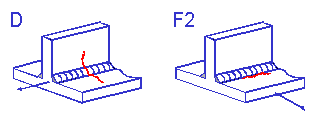
Two fillet welds are shown below. One is loaded parallel to the weld toe ( Class D ) and the other loaded perpendicular to the weld toe ( Class F2 ).
It is then assumed that any complex weld geometry can be described by one of the standard classifications.
Material Properties
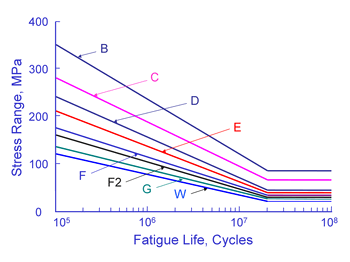
The curves shown above are valid for structural steel welds. Fatigue lives are not dependant on either the material or the applied mean stress. Welds are known to contain small cracks from the welding process. As a result, the majority of the fatigue life is spent in growing these small cracks. Fatigue lives are not dependant on material because all structural steels have about the same crack growth rate. The crack growth rate in aluminum is about ten times faster than steel and aluminum welds have much lower fatigue resistance. Welding produces residual stresses at or near the yield strength of the material. The as welded condition results in the worst possible residual or mean stress and an external mean stress will not increase the weld toe stresses because of plastic deformation. Fatigue lives are computed from a simple power function.

The constant C is the intercept at 1 cycle and is tabulated in the standard. This constant is much larger than the ultimate strength of the material.
The standard is only valid for fatigue lives in excess of 105 cycles and limits the stress to 80% of the yield strength. Experience has shown that the SN curves provide reasonable estimates for higher stress levels and shorter lives. In eFatigue, the maximum stress range permitted is limited by the ultimate strength of the material for all weld classes.
Design Criteria
Test data for welded members has considerable scatter as shown below for butt and fillet welds.
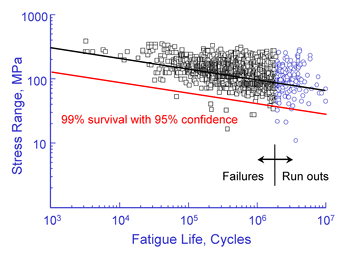
Some of this scatter is reduced with the classification system that accounts for differences between the various joint details. The standard give the standard deviation of the various weld classification SN curves.
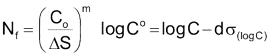
The design criteria d is used to determine the probability of failure and is the number of standard deviations away from the mean. For example d = 2 corresponds to a 2.3% probability of failure and d = 3 corresponds to a probability of failure of 0.14%.
%!s(int=2026) © %!d(string=Wise Deck)