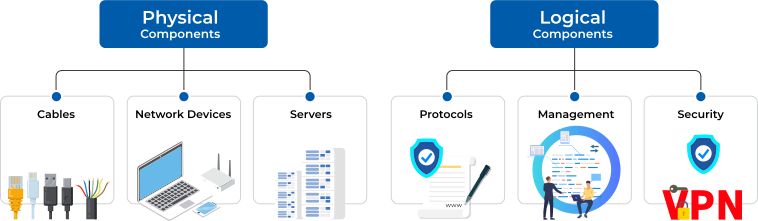
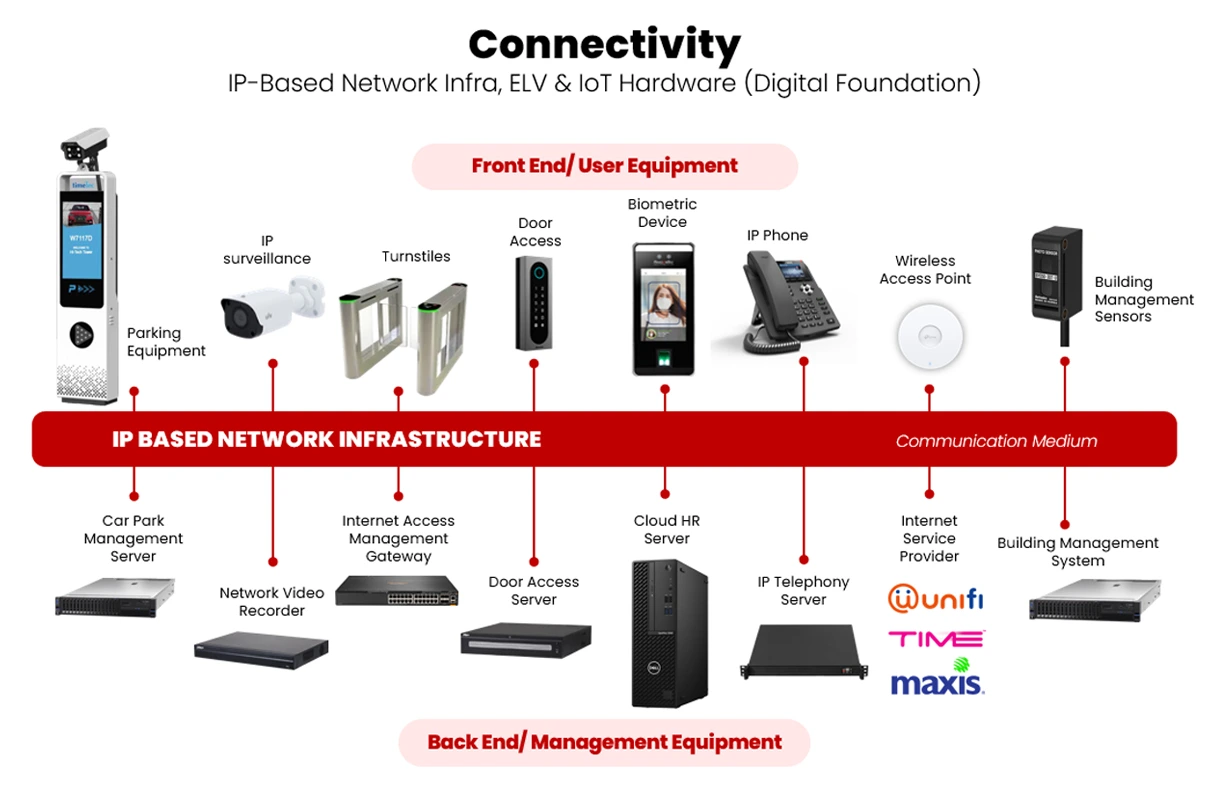
TimeTec offers complete Network Infrastructure solutions alongside our comprehensive PropTech ecosystem, delivering seamless connectivity to support smart building operations. From structured cabling to high-performance network equipment, our infrastructure services are designed to integrate flawlessly with TimeTec’s PropTech solutions—including smart access and elevator control, ELV & IoT automation, smart cashless and touchless parking, visitor management and etc., ensuring a reliable, scalable, and future-ready environment for modern commercial and residential buildings.
What Is a Well-Designed Network Infrastructure?
A well-designed network infrastructure is essential for any organization that relies on technology to operate effectively. It provides the foundation for integrating emerging technologies and new applications, allowing businesses to remain agile, up-to-date, and competitive in their industries.
For service providers, building a robust network infrastructure means ensuring scalability, high availability, and intelligent load balancing. These elements are critical to maintaining seamless connectivity and reliable system performance—key factors in today’s fast-paced digital environment.
Since network interruptions can never be entirely avoided, it's also vital to adopt streamlined network architectures and automated management tools. These help network administrators quickly identify, isolate, and resolve issues, minimizing downtime and ensuring optimal network functionality.
The world of embedded systems development is a complex and ever-evolving landscape, where engineers and developers are constantly pushing the boundaries of what is possible with microcontrollers and other embedded devices. One of the most popular and widely used families of microcontrollers is the ARM (Advanced RISC Machines) family, which has become the de facto standard for a wide range of applications, from simple consumer electronics to complex industrial control systems.
Whether you're working on a simple consumer electronics project or a complex industrial control system, IAR Embedded Workbench For ARM 8.32.1 ARM provides the tools and features you need to unlock the full potential of ARM-based microcontrollers. With its support for the latest ARM processors, improved performance and code generation, and enhanced debugging capabilities, IAR Embedded Workbench For ARM 8.32.1 ARM is the perfect choice for any ARM-based development project.
The latest version of IAR Embedded Workbench For ARM, version 8.32.1, includes a range of new features and improvements, including support for the latest ARM Cortex-M processors, improved performance and code generation, and enhanced debugging capabilities. This makes it an ideal choice for developers working on a wide range of ARM-based projects, from simple applications to complex systems.
IAR Embedded Workbench For ARM 8.32.1 ARM is a powerful and feature-rich development environment that provides a comprehensive set of tools and resources for developing and debugging ARM-based applications. With its highly optimizing compiler, powerful debugger, and intuitive project manager, IAR Embedded Workbench For ARM 8.32.1 ARM is an essential tool for any engineer or developer working with ARM microcontrollers.
Iar Embedded Workbench For Arm 8.32.1 | Arm
The world of embedded systems development is a complex and ever-evolving landscape, where engineers and developers are constantly pushing the boundaries of what is possible with microcontrollers and other embedded devices. One of the most popular and widely used families of microcontrollers is the ARM (Advanced RISC Machines) family, which has become the de facto standard for a wide range of applications, from simple consumer electronics to complex industrial control systems.
Whether you're working on a simple consumer electronics project or a complex industrial control system, IAR Embedded Workbench For ARM 8.32.1 ARM provides the tools and features you need to unlock the full potential of ARM-based microcontrollers. With its support for the latest ARM processors, improved performance and code generation, and enhanced debugging capabilities, IAR Embedded Workbench For ARM 8.32.1 ARM is the perfect choice for any ARM-based development project. IAR Embedded Workbench For ARM 8.32.1 ARM
The latest version of IAR Embedded Workbench For ARM, version 8.32.1, includes a range of new features and improvements, including support for the latest ARM Cortex-M processors, improved performance and code generation, and enhanced debugging capabilities. This makes it an ideal choice for developers working on a wide range of ARM-based projects, from simple applications to complex systems. The world of embedded systems development is a
IAR Embedded Workbench For ARM 8.32.1 ARM is a powerful and feature-rich development environment that provides a comprehensive set of tools and resources for developing and debugging ARM-based applications. With its highly optimizing compiler, powerful debugger, and intuitive project manager, IAR Embedded Workbench For ARM 8.32.1 ARM is an essential tool for any engineer or developer working with ARM microcontrollers. With its support for the latest ARM processors,