Home
About Us
Products
Process Models
SE Resources
Commentary
Contact us
|
|
|
Breaking News!
A new blog ...
Bettie Bondage Simpcity -
Bettie Bondage Simplicity is more than just a fleeting trend; it's a movement towards reevaluating our relationship with fashion, aesthetics, and the concept of beauty. By embracing simplicity and integrating elements of bondage in an artistic manner, it offers a unique perspective on elegance and restraint. As we continue to explore and understand this fascinating concept, we may find ourselves drawn to its underlying principles: that sometimes, less is more, and that restraint can be a form of freedom.
In a world that often seems overwhelmed by complexity and excess, Bettie Bondage Simplicity offers a refreshing counterpoint. It invites us to appreciate the beauty in restraint, to find elegance in simplicity, and to explore the boundaries of fashion and art in a creative and thought-provoking way. bettie bondage simpcity
In the realm of fashion and aesthetics, there exist numerous styles and themes that captivate the imagination and inspire creativity. One such intriguing concept is "Bettie Bondage Simplicity," a term that may seem enigmatic at first glance but embodies a unique blend of elegance, restraint, and uncomplicated beauty. This article aims to delve into the heart of Bettie Bondage Simplicity, exploring its origins, key characteristics, and the reasons behind its growing popularity. Bettie Bondage Simplicity is more than just a
The concept of Bettie Bondage Simplicity draws inspiration from various sources, including the minimalist art movement, the elegance of Japanese Kimono design, and the provocative aspects of bondage culture. The term itself seems to nod towards the iconic "Bettie Page," a model known for her playful yet sophisticated approach to fashion and her embrace of bondage themes in her work. Over time, Bettie Bondage Simplicity has evolved, influenced by contemporary designers and artists who seek to push the boundaries of fashion, exploring new ways to merge simplicity with the allure of restraint. In a world that often seems overwhelmed by
So, what draws people to Bettie Bondage Simplicity? For some, it's the intellectual stimulation of engaging with a form of art that challenges traditional perceptions of beauty and restraint. For others, it's the aesthetic appeal of clean lines, elegant designs, and the intriguing interplay of bondage elements.
Bettie Bondage Simplicity is not merely a style or a trend but an art form that combines the principles of simplicity with the aesthetic of bondage. At its core, it is about stripping down to the essentials, focusing on clean lines, minimalistic designs, and a monochromatic or limited color palette, while incorporating elements of bondage in a tasteful and artistic manner. This fusion results in a visually striking and thought-provoking form of expression that challenges conventional norms of beauty and restraint. |
|
|
|
|
|
|
|
|
|
|
|
|
|
|
| The newest edition! |
|
 |
Another novel by
Roger Pressman! |
|
 |
|
|
|
|
|
Available in trade paperback and e-book editions. For more information, click here. |
|
|
|
|
|
|
|
|
|
|
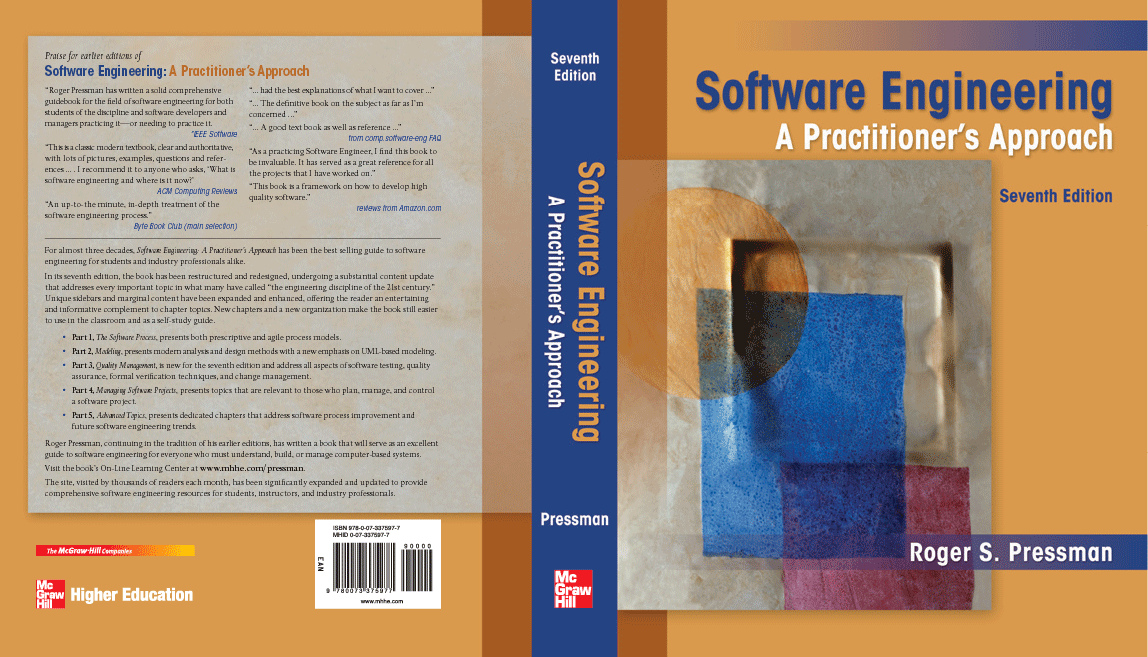
The seventh edition of Software Engineering: A Practitioner's Approach is intended to serve as a guide to a maturing engineering discipline. The seventh edition, like the six editions that preceded it, is intended for both students and practitioners, retaining its appeal as a guide to the industry professional and a comprehensive introduction to the student at the upper level undergraduate or first year graduate level.
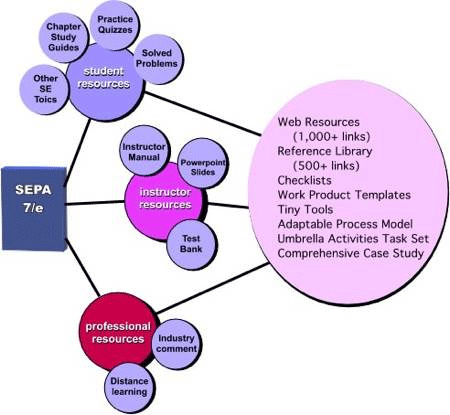
The seventh edition is considerably more than a simple update. The book has been revised and restructured to improve pedagogical flow and emphasize new and important software engineering processes and practices. In addition, a revised and updated “support system,” illustrated below, provides a comprehensive set of student, instructor, and professional resources to complement the content of the book.
|
|
|
|
 |
|
|
The 32 chapters of the seventh edition have been reorganized into five parts. This organization, which differs considerably from the sixth edition, has been done to better compartmentalize topics and assist instructors who may not have the time to complete the entire book in one term.
Part 1, The Process, presents a variety of different views of software process, considering all important process models and addressing the debate between prescriptive and agile process philosophies. Part 2, Modeling, presents analysis and design methods with an emphasis on object-oriented techniques and UML modeling. Pattern-based design and design for Web applications are also considered. Part 3, Quality Management, presents the concepts, procedures, techniques, and methods that enable a software team to assess software quality, review software engineering work products, conduct SQA procedures, and apply an effective testing strategy and tactics. In addition, formal modeling and verification methods are also considered. Part 4, Managing Software Projects, presents topics that are relevant to those who plan, manage, and control a software development project. Part 5, Advanced Topics, considers software process improvement and software engineering trends. Continuing in the tradition of past editions, a series of sidebars is used throughout the book to present the trials and tribulations of a (fictional) software team and to provide supplementary materials about methods and tools that are relevant to chapter topics. Two new appendices provide brief tutorials on UML and object-oriented thinking for those who may be unfamiliar with these important topics.
The five-part organization of the seventh edition enables an instructor to "cluster" topics based on available time and student need. An entire one-term course can be built around one or more of the five parts. A software engineering survey course would select chapters from all five parts. A software engineering course that emphasizes analysis and design would select topics from Parts 1 and 2. A testing-oriented software engineering course would select topics from Parts 1 and 3, with a brief foray into Part 2. A "management course" would stress Parts 1 and 4. By organizing the seventh edition in this way, I have attempted to provide an instructor with a number of teaching options. |
|
|
Software Engineering: A Practitioner's Approach
7th Edition
Table of Contents
Chapters
1. Software and Software Engineering
Part I - Process
2. Process Models
3. Agile Development
Part II - Modeling
4. Practice: A Generic View
5. Understanding Requirements (new chapter)
6. Requirements Modeling: Scenarios and Data (new chapter)
7. Requirements Modeling: Flow, Classes, and Behavior (new chapter)
8. Design Concepts (new chapter)
9. Architectural Design
10. Component-Level Design
11. Usability design (new chapter)
12. Pattern-based Design (new chapter)
13. WebApp Design
Part III - Quality Management
14. Quality Concepts (new chapter)
15. Software reviews (new chapter)
16. Software Quality Assurance
17. Software Testing Strategies
18. Testing Methods for Conventional Software (new chapter)
19. Testing Methods for OO Software (new chapter)
20. Testing Methods for WebApps
21. Advanced Verification Methods (new chapter)
22. Software Configuration Management
23. Product Metrics
Part IV - Project Management
24. Management Concepts
25. Process and Project Metrics
26. Estimation
27. Scheduling
28. Risk Management
29. Maintenance and Reengineering (new chapter)
Part V-Advanced Topics
30. Software Process improvement (new chapter)
31. Emerging Trends in Software Engineering (new chapter)
32. The Road Ahead
Appendix I - UML Tutorial (new)
Appendix II - OO Concepts (new)
|
|
|
|
|
|
|
|
|
Home About us Products Product Models SE Resources Commentary Contact us
Web site and all contents © 2001-2009, R.S. Pressman & Associates, Inc., All rights reserved.
Free website templates
|
|