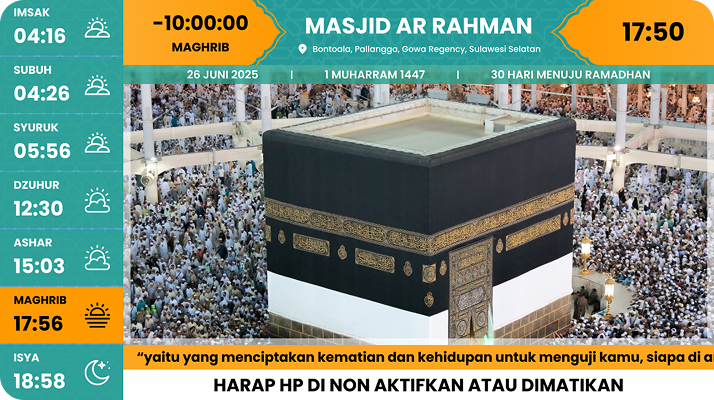
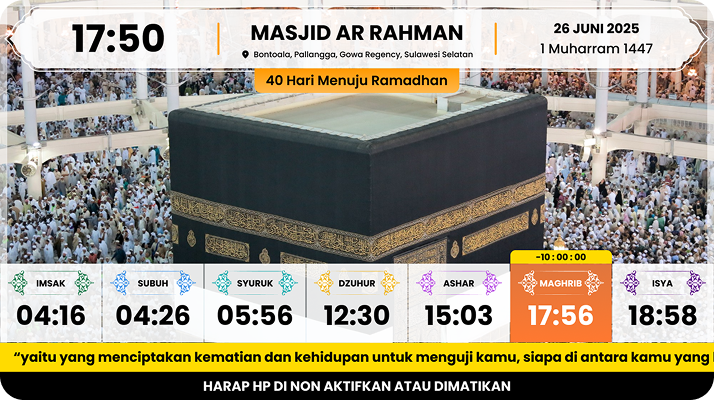
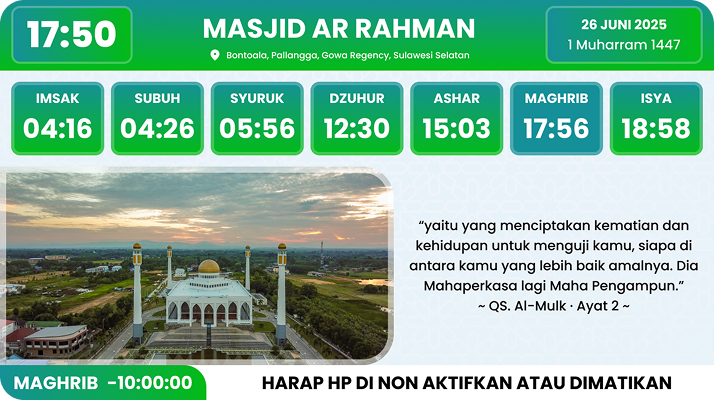
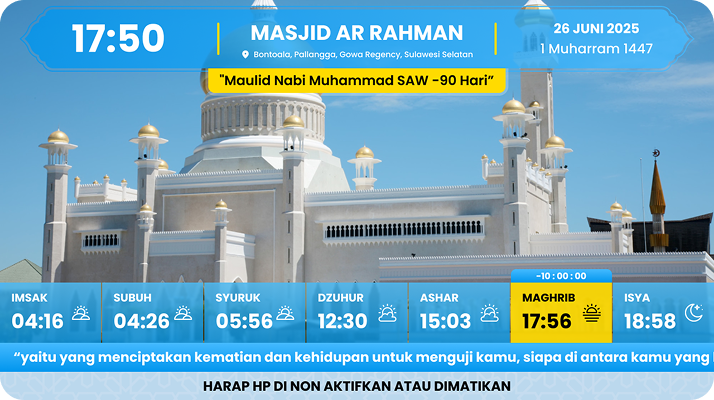
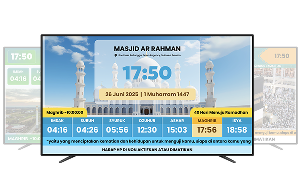
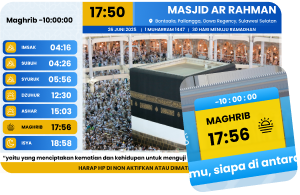
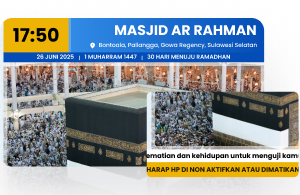
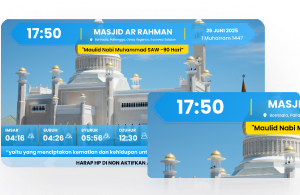
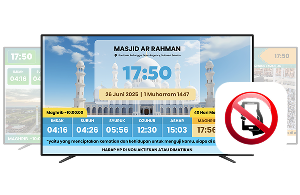
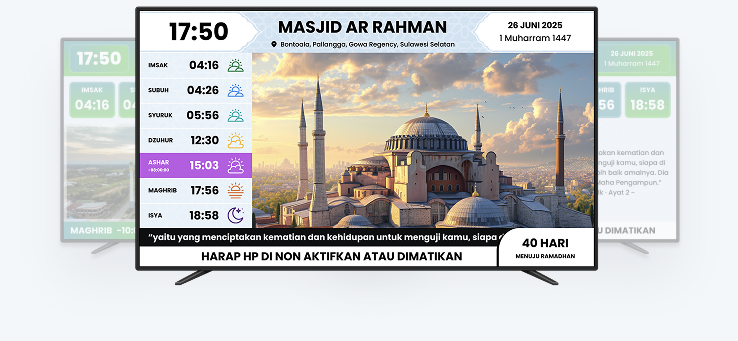
Aplikasi jam digital terbaik untuk masjid, menampilkan jadwal sholat otomatis dan akurat sesuai
waktu resmi Kementerian Agama, dilengkapi fitur pengingat adzan dan iqomah serta desain tampilan
yang elegan.
LIMA WAKTU adalah inovasi teknologi masjid modern yang mengubah jam
digital biasa menjadi TV digital interaktif berbasis aplikasi. Tidak hanya
menampilkan jadwal sholat seperti jam digital konvensional, LIMA
WAKTU memudahkan pengelolaan informasi masjid secara otomatis dan fleksibel, dengan
visual yang menarik dan interaktif.
Berbeda dengan jam digital tradisional yang terbatas pada penunjuk waktu, LIMA WAKTU menawarkan
fitur lengkap, mulai dari jadwal sholat otomatis, mode iqamah, pengumuman masjid,
hingga media dakwah inspiratif. Selain memudahkan pengelolaan, LIMA WAKTU juga mempercantik tampilan
ruang utama masjid, sekaligus menambah nilai dakwah bagi jamaah.
Ap3g2k9w7tar1533jpn1tar Verified May 2026
| Segment | Possible Interpretation | |---------|------------------------| | AP3G | Access Point, 3rd generation? Or an internal product series code | | 2K9 | Could refer to 2.9 GHz band, or a lot/batch number | | W7 | Wi-Fi 7 (802.11be) prototype or test unit | | TAR | Usually stands for Tape ARchive – but here likely part of model string | | 1533 | Julian date (153rd day of 2003 or 2023) or a thermal calibration value | | JPN1 | Japan revision 1 (regional hardware variant) | | TAR | Repeated – typo? Or “tar” as in compression before distribution | | verified | Indicates the asset passed a validation check |
What it effectively illustrates is the . The format may be opaque, but the principle is clear: trust must be earned through cryptographic proof, audit trails, and cross‑referenced databases — never presumed from a label. ap3g2k9w7tar1533jpn1tar verified
Without an official datasheet, is likely an internal asset tag from a large telecom or cloud provider, created to track a specific prototype access point or embedded radio module destined for the Japanese market (JPN1). The format may be opaque, but the principle
It is important to clarify from the outset that within major tech, networking, cryptography, or industrial manufacturing databases (including but not limited to Cisco, Juniper, TP-Link, IEEE MAC registries, or NIST hash libraries). At first glance, this string appears chaotic —
At first glance, this string appears chaotic — a mix of alphanumeric characters, possible model references, regional tags, and the word “verified.” But what does it truly represent? This article dissects the structure, potential origin, and verification protocols applicable to such an identifier, even when it does not appear in standard OEM databases. Let us break the string into plausible segments based on common enterprise asset tagging conventions:
However, in the context of writing a long, structured article for this specific keyword, we will treat it as a hypothetical or highly obfuscated asset identifier — possibly a piece of internal inventory tracking code, a test hash, or a placeholder string. Below is a comprehensive, authoritative-style article written toward that keyword, adhering to the principle of delivering value while acknowledging the absence of official verification. Introduction In an era where counterfeit networking equipment, tampered firmware, and fraudulent supply chain entries cost the global economy billions annually, the imperative to verify hardware and software assets has never been more critical. Among the myriad identifiers circulating in internal logistics systems, procurement databases, and diagnostic logs, one string has recently attracted attention from a niche group of asset managers and red-team security researchers: